Explore Simulation and Clinical Skills
The Simulation and Clinical Skills programs at Alice L. Walton School of Medicine (AWSOM) are designed to equip and support future physicians to successfully tackle complex health care challenges. Through immersive simulation, deliberate practice, and early clinical skills integration, students develop clinical competence, diagnostic reasoning, and effective interprofessional communication in a safe, learner-centered environment.

The program is grounded in the core values of empathy, emphasizing compassionate, patient-centered care while fostering professional identity formation. Innovation and utilization of appropriate emerging technologies are embedded throughout the curriculum, empowering students to creatively solve clinical and systems-level problems and evidence-based approaches.

Simulation
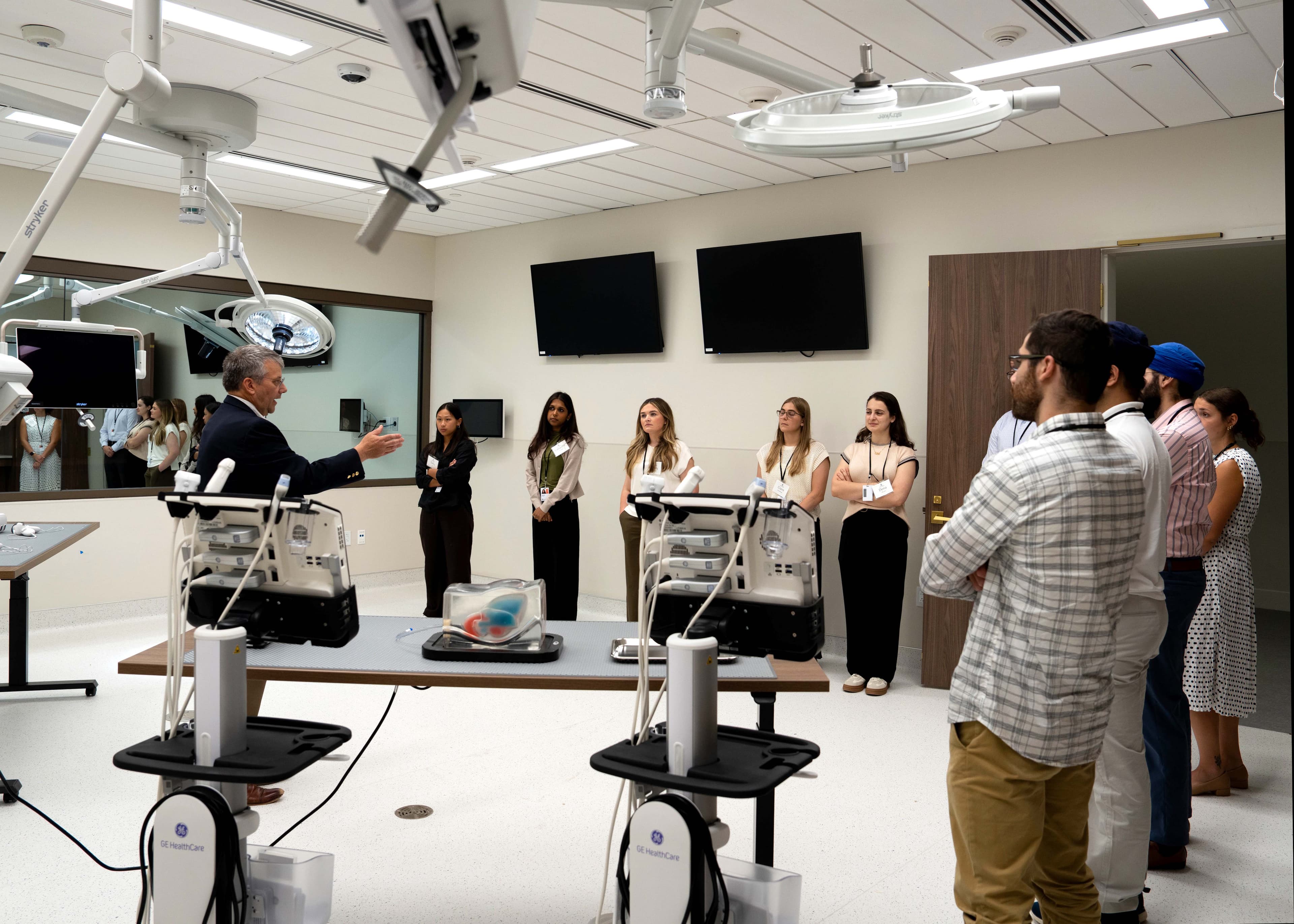
AWSOM's Simulation Lab is an over 8,800-square-foot learning environment with four flexibly configured simulation suites equipped with audio-video recording and one-way mirrored control rooms. Nearby are four debriefing classrooms for after-action reflection, hands-on integrated active learning, and student interest group activities. The debriefing space has three dividers allowing configuration as one large room or a combination of smaller rooms.
Meet the Team
Kevin Kunkler, MD, MS | Professor and Assistant Dean Simulation, Innovation, and Clinical Skills
Sylvia Merino, MBA, MPH | Instructor and Director, Simulation
Emily Simpson, MA | Extended Reality Simulation Specialist
Medical Simulation
Medical simulation is a training and education method that replicates authentic clinical scenarios using standardized patients, manikins, virtual reality, computer models, and more.
It allows medical students to practice history-taking, physical examination, procedural skills, and clinical reasoning and teamwork in an immersive, controlled environment without risking harm to clinical patients. Students practice common medical tasks using an array of educational technologies including:
- Standard surgical scrub sinks
- Operation room boom arms with adjustable surgical overhead lighting and cameras
- Full-body human patient simulators
- Simulated ICU monitors to represent normal and abnormal ranges of vital patient data
- Simulated electronic medical record systems to familiarize workflow and safety concepts on outpatient and inpatient data
- Part-task trainers and medical supplies for specific technical procedural skills
- Virtual/mixed reality headsets to visualize human anatomy, radiological imaging, and immersive clinical skills scenarios
- Software programs that provide real-time visualization of anatomical and physiological concepts
- Medical moulage to enhance engagement and realism
Many of these technologies are mobile and can be used anywhere in the building to support integrated learning opportunities.


Clinical Skills
AWOM's Clinical Skills Center is a 16,900-square-foot educational facility designed to provide medical students with hands-on, faculty-supervised training in clinical skills. Working alongside standardized patients, individuals trained to portray clinical patients, students develop essential patient-centered communication, history-taking, physical examination, and clinical reasoning skills in a safe and supportive learning environment.
Meet the Team
Kevin Kunkler, MD, MS | Professor and Assistant Dean, Simulation, Innovation, and Clinical Skills
Christina Harris, MPM | Clinical Skills Operations Manager
Maker Space
The Maker Space invites students to work creatively with cutting-edge maker technology. Students can learn 3D modeling software and printing in a dedicated space that provides fused deposition modeling (FDM) and PolyJet printers for varied applications. Post-printing production tools, equipment, and technical support are also available.
As part of the School’s commitment to research and innovation, this space is a hands-on lab where students can design, prototype, and test concepts on printed models. The experience on educational projects allows students to build skillsets for rapid prototyping of concepts or components. This learning enhances student opportunities for future clinical research and translation positions.
The Maker Space includes:
Computer stations with software for model creation
FDM 3D printers (Prusa Core One)
PolyJet 3D printers (StrataSys J5)
UV curing station